


Release time:2020-01-16 18:44 Browse:
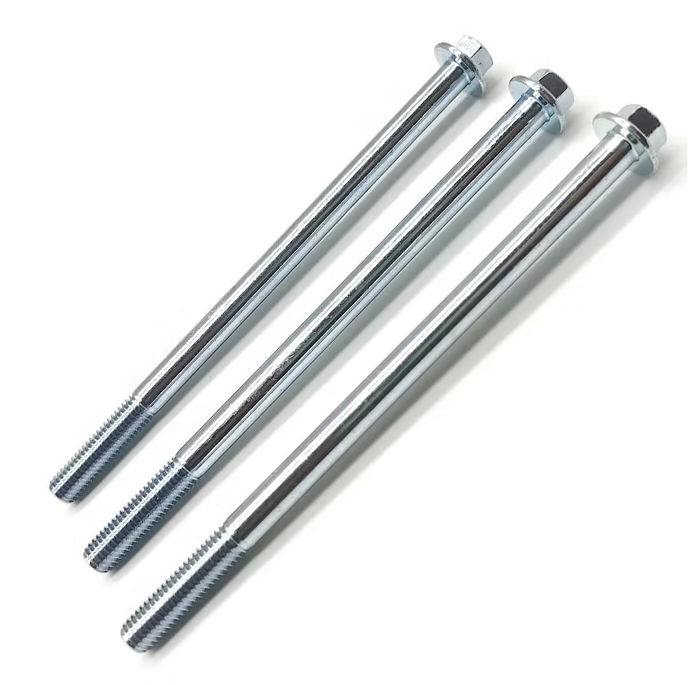
Electroplating bolts over 500mm in length and ensuring their quality requires special attention due to their unique challenges related to length, such as suspension in the plating tank, uniformity of current distribution, and subsequent handling, which differ from standard bolts.
Here’s how to approach electroplating for extended bolts and ensure quality, broken down into key areas:
I. Challenges in Electroplating Extended Bolts
Electroplating extended bolts (over 500mm) presents more challenges than standard fasteners, primarily due to their size:
Difficulty Ensuring Coating Uniformity: Current distribution during traditional electroplating can be uneven, potentially leading to a thinner coating in the middle section of the bolt and excessive buildup at the ends or edges. This "Edge Effect" is more pronounced for ultra-long screws.
Susceptibility to Deformation or Damage: Due to their weight and length, extended bolts are more prone to bending or thread damage during suspension, immersion/withdrawal from the plating tank, and drying if handled improperly or without adequate support.
Higher Risk of Hydrogen Embrittlement: Hydrogen atoms can more easily penetrate the metal substrate during electroplating, especially during pre-treatment pickling. For long bolts, the stress state might be more complex, potentially increasing susceptibility to hydrogen embrittlement.
Equipment Limitations: Requires sufficiently long and deep electroplating tanks, cleaning tanks, and places higher demands on the stability and uniformity of the rectifier's current output.
II. Key Processing Steps and Countermeasures
Addressing the above challenges involves these critical steps and strategies:
Pre-Treatment (Cleaning) - Crucial
Precise Degreasing and Picking: Must thoroughly remove surface oil, rust, and oxides to ensure good adhesion of the plating layer. For long bolts, pay special attention to pickling time and concentration to avoid over-corrosion. Consider mechanical cleaning (e.g., sandblasting) to reduce or replace pickling time, minimizing hydrogen intake.
Activation and Rinsing: After activation, rinse thoroughly with pure water to prevent contaminant ions from entering the plating bath.
Electroplating Process Control - Core Phase
Specialized Rack Design: This is key for plating long bolts. Must use rigid, specially designed racks with uniform conductivity. Typically, multiple contact points along the bolt's length are needed, and possibly auxiliary anodes or protective cathodes in the middle section, to improve current distribution and ensure uniform coating thickness.
Selecting the Right Plating Process: For long bolts, Zinc-Nickel alloy plating is an excellent option. Its throwing power and covering power are superior to standard zinc plating, better meeting the uniform coating needs of long bolts, and it offers exceptional corrosion resistance (e.g., can achieve 720 hours neutral salt spray test without red rust).
Precise Control of Process Parameters: Strictly control bath temperature, current density, pH value, and plating time. For long bolts, starting with a slightly lower current density than normal and using techniques like live entry might be necessary for a more uniform deposit.
Post-Treatment - Essential
Effective Hydrogen Embrittlement Relief: Baking for hydrogen relief must be performed immediately after plating (typically heating to 190-230°C, holding for 8-24 hours, depending on bolt material and strength grade). This is the most effective measure to prevent hydrogen embrittlement fracture. Critically important for high-strength steel long bolts.
Appropriate Passivation and Sealing: Choose the appropriate passivation process based on the plating type (e.g., chromate conversion coatings for zinc: yellow, black, blue) to form a protective film enhancing corrosion resistance. Consider adding a sealing treatment (applying a thin organic coating) which can significantly boost corrosion protection, sometimes multiplying the salt spray test resistance.
Careful Drying: Dry gently to avoid collisions that could damage the coating.
III. Ensuring Electroplating Quality: Inspection and Control Points
To guarantee the quality of ultra-long screw electroplating, strict quality inspection standards must be established:
Coating Thickness Measurement: Use an eddy current or magnetic thickness gauge to take multiple measurements at different points on the bolt (especially the head, middle of the shank, thread crest, and root). Ensure thickness meets requirements (e.g., typically 4-12μm for economical plating) and is as uniform as possible.
Adhesion Test: Use methods like friction or cross-cut tests to check the bonding strength between the coating and substrate, ensuring the coating doesn't peel or flake.
Corrosion Resistance Test: Primarily assessed via Neutral Salt Spray Test (NSS Test). Record the time until white corrosion products and red rust first appear to verify if corrosion resistance meets expectations (e.g., 720 hours no red rust).
Visual Inspection: Visually inspect, optionally with magnification. The coating should be smooth, uniform, consistent in color, and free from blisters, peeling, roughness, nodules, or significant streaks.
Hydrogen Embrittlement Assessment: For high-strength bolts, consider methods like sustained load testing or delayed failure tests to evaluate susceptibility. Strict baking is the primary prevention.
IV. Practical Advice for You
Close Communication with Suppliers: Finding a reliable electroplater with experience in plating extra-long parts is crucial. Clearly communicate your product specifications, service environment (e.g., marine), and performance requirements (e.g., salt spray resistance hours, hydrogen embrittlement requirements).
Provide Detailed Technical Agreement: Specify the plating standard (e.g., GB/T 5267.1 equivalent to ISO 4042), coating thickness requirements, passivation type, hydrogen embrittlement relief requirements, and acceptance criteria (especially salt spray test time and HE test requirements) in the order.
Consider Alternative Processes: If electroplating struggles to meet extreme requirements, explore processes like Dacromet or Geomet (non-chromate zinc-aluminum coatings). They offer no hydrogen embrittlement risk, generally superior corrosion resistance compared to electroplating, and better coating uniformity advantages for long bolts. Note: They may affect thread fit and are non-conductive.
First Article Inspection and Process Audit: For critical projects, require the plater to perform a first article run and provide comprehensive inspection reports. Conduct audits of their production process if necessary, focusing on racks, current control, and hydrogen embrittlement relief procedures.