


Release time:2020-01-16 18:44 Browse:
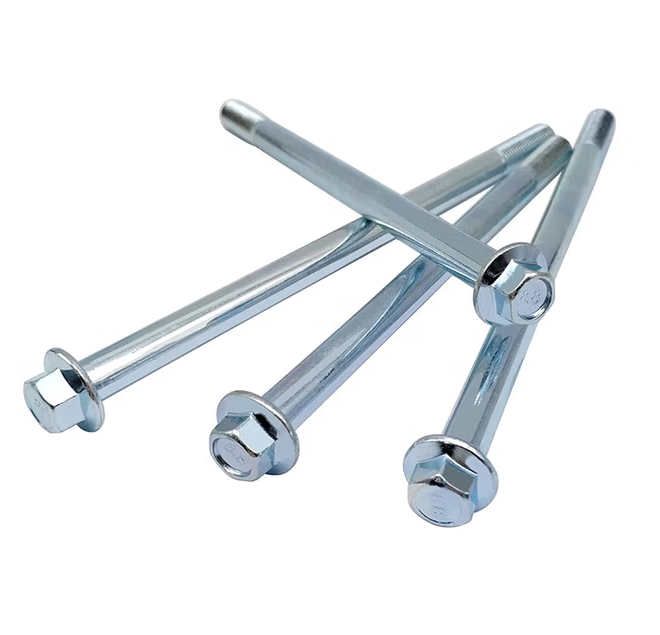
Can Non-Quenched and Tempered Steel Be Used Directly to Process Grade 8.8 Products for Extra-Long Screws?
This is a very professional and important question. The short answer is: It is technically possible but highly risky and generally not recommended, especially for applications demanding high reliability and safety.
Here’s a detailed explanation of why and the key considerations.
Core Conclusion: Not Recommended
For grade 8.8 extra-long screws, it is not recommended to use non-quenched and tempered steel (Non-QT steel) for direct machining. The main reasons are the difficulty in meeting the strict requirements of grade 8.8 regarding mechanical properties, microstructure, and the specific challenges posed by the long length.
Detailed Analysis and Reasons
1. What is Non-Quenched and Tempered Steel?
Non-QT steel (e.g., China's YF40MnV, Japan's SWRCHB series) is a micro-alloyed steel. By adding trace elements like Vanadium (V), Niobium (Nb), or Titanium (Ti), the carbonitrides of these elements precipitate during cooling after rolling or forging. This provides precipitation strengthening and grain refinement, allowing the steel to achieve relatively high strength without undergoing quenching and tempering heat treatment.
Its advantages are:
Eliminates heat treatment steps, saving energy and cost.
Avoids heat treatment distortion, making dimensional accuracy easier to control for complex parts.
Avoids quenching cracks and hydrogen embrittlement risk.
2. Performance Requirements for Grade 8.8 Bolts (per ISO 898-1 or GB/T 3098.1)
Grade 8.8 defines specific mechanical property requirements, not just hardness:
Tensile Strength (Rm): ≥800 MPa
Yield Strength (Rp0.2): ≥640 MPa
Elongation after Fracture (A): ≥12%
Hardness: 250-320 HV
Impact Energy: Minimum requirements (especially in low-temperature environments)
3. Why Non-QT Steel Struggles to Meet Requirements for Extra-Long Grade 8.8 Screws?
| Aspect | Quenched & Tempered Steel (Traditional Process) | Non-QT Steel (Direct Machining) | Impact on Extra-Long Screws |
|---|---|---|---|
| Property Uniformity | Excellent. Through overall quenching and tempering, the microstructure (tempered martensite/sorbite) and mechanical properties are uniform throughout the cross-section. | Poor. Properties depend on the cooling rate after rolling/forging. The core cools much slower than the surface, leading to significantly lower strength and toughness in the core, resulting in non-uniform properties. | Critical flaw. For long, large-diameter screws, core property non-uniformity is magnified. The core becomes the weak point under load, potentially causing premature failure. |
| Toughness Reserve | High. The tempered microstructure offers a good strength-toughness balance, especially excellent low-temperature impact toughness. | Relatively Lower. The microstructure of non-QT steel is typically ferrite + pearlite or bainite. Its toughness, particularly low-temperature impact toughness, is usually lower than equivalent QT steel. | High risk. Long screws may withstand impact, vibration, or eccentric loads during installation/use, requiring good toughness. insufficient toughness increases the risk of brittle fracture. |
| Size Effect | Minimal impact. Heat treatment ensures consistent properties across different diameters/lengths (with proper process control). | Significant impact. Properties heavily depend on cooling rate. Larger diameters and greater lengths increase cooling differences across the section, leading to greater property fluctuation and inconsistency. | Uncontrollable. For "extra-long" sizes, ensuring full-length and full cross-section properties are uniformly and stably up to grade 8.8, especially toughness and yield strength, is nearly impossible. |
| Standard Compliance | Fully compliant. The standard and recognized material and process for manufacturing Grade 8.8 and higher bolts. | Generally non-compliant. Most international and national standards (e.g., ISO 898-1) do not recognize non-QT steel for direct manufacture of Grade 8.8 bolts. Material and product certification will be difficult. | Legal & commercial risk. Liability is enormous if product failure occurs due to material issues when using non-standard processes/materials. |
Alternative Solutions and Recommendations
Preferred Solution: Use Traditional QT Steel and Heat Treatment
Select quality medium carbon steel (e.g., 35#, 45#) or alloy steel (e.g., 35CrMo, 42CrMo).
Perform through-hardening heat treatment (quenching and tempering) after machining to ensure a uniform tempered microstructure.
For extra-long screws, heat treatment is the key challenge. Find an experienced heat treater with deep pit furnaces or continuous heat treatment lines to ensure uniform rapid quenching (avoiding distortion) and uniform tempering temperature for consistent properties.
Adequate baking for hydrogen embrittlement relief is mandatory after electroplating.
Exploratory Option: High-Performance Non-QT Steel (Requires Strict Validation)
Full-Length, Full-Section Property Testing: Sample not only the surface but also the core at various lengths for tensile, impact, and hardness tests to ensure uniform达标 (meeting standards).
Fatigue Performance Testing: Bolts often endure cyclic loads; fatigue performance is crucial.
Low-Temperature Impact Testing: Assess toughness reserve in cold environments.
Process Stability Verification: Repeat validation across different material batches.
Some advanced non-QT steels approach the 800MPa level.
If insisted upon, extremely comprehensive validation is mandatory:
Even if validation passes, explicit customer approval is needed, accepting associated risks.
Summary
For extra-long screws, where the size effect is significant and demands higher property uniformity and consistency, it is strongly discouraged to use non-QT steel direct machining for producing Grade 8.8 products.
The most reliable, standards-compliant, and lowest-risk method remains:
Select suitable quenched and tempered steel material + Precision Machining + Professional controlled heat treatment (quenching & tempering) + Comprehensive finishing (e.g., plating & hydrogen baking).